
Canada & Ontario Just Cut Development Charges 50%
Development charges in Ontario 2026 are being cut 50% under the new Canada-Ontario $8.8 billion housing partnership.
GTA buyers in Vaughan, Toronto, Mississauga, Brampton, and GTA could save up to $170,000 on a new home by combining development charge relief with federal GST and Ontario HST rebates.
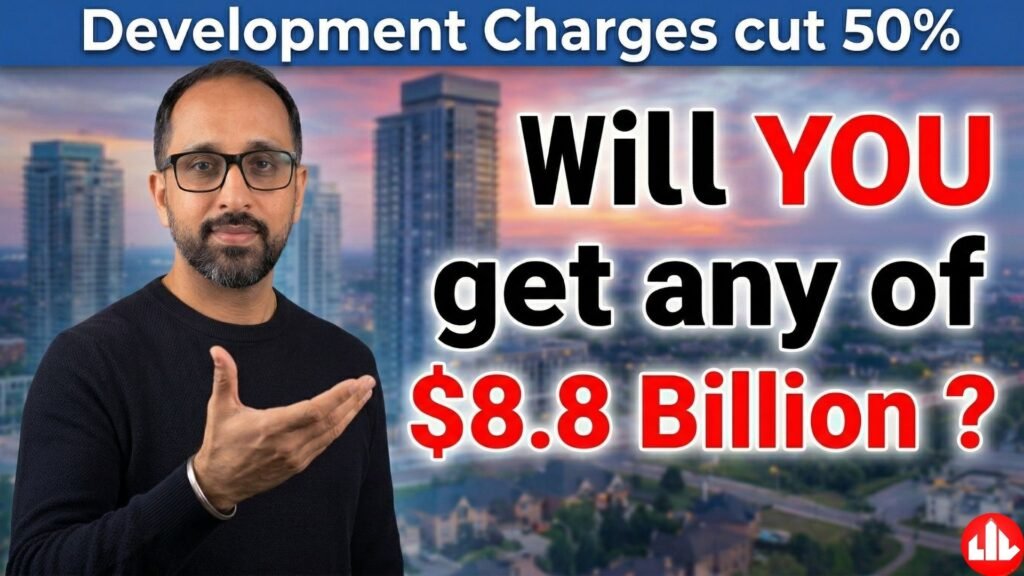
Development Charges Ontario 2026 – Full Breakdown
What You Need to Know Right Now
On March 30, 2026, Prime Minister Mark Carney and Premier Doug Ford announced a landmark $8.8 billion federal-provincial housing deal. The goal is straightforward: force municipalities to slash the fees builders pay before breaking ground — and in doing so, bring down the cost of new homes across Ontario.
- 1$8.8 billion in joint funding tied directly to municipalities cutting Development Charges by 50% on new homes.
- 2For GTA buyers: a potential $40,000–$65,000 off the purchase price of a new home — if builders pass the savings through.
- 3Stack that with federal GST and Ontario HST rebates and you're looking at up to $170,000 in total savings on the right property.
- 4Reduced rates start January 1, 2027. Municipalities must opt in by June 30, 2026.
What Are Development Charges — and Why Do They Matter?
A Development Charge (DC) is a fee municipalities charge builders before construction begins. It funds local infrastructure — roads, water systems, sewers. Builders don't absorb it. They pass it straight to home buyers through the purchase price.
In Vaughan, that fee is currently $95,000 per single-family home. In Toronto, $97,041. These are among the highest in North America — and they've been a primary reason new construction in the GTA has stalled.
The Rules for Municipalities
- 50% reduction required on all residential unit types
- Lock-in period: January 1, 2027 – December 31, 2029
- Must submit approved lists of housing-enabling infrastructure projects
- Priority given to high-growth cities covering 80% of Ontario's population
The Timeline
Development Charges — Before & After
Effective January 1, 2027, for municipalities that opt in. All figures reflect a straight 50% reduction on current published rates.
| City | SFH Current | SFH After Cut | SFH Saving | Condo Current | Condo After Cut | Condo Saving |
|---|---|---|---|---|---|---|
| 📍 Vaughan | $95,000 | $47,500 | ▼ $47,500 | $157,643 | $78,822 | ▼ $78,822 |
| Toronto | $97,041 | $48,520 | ▼ $48,521 | $165,000 | $82,500 | ▼ $82,500 |
| Pickering | $125,000 | $62,500 | ▼ $62,500 | $110,000 | $55,000 | ▼ $55,000 |
| Mississauga | $75,000 | $37,500 | ▼ $37,500 | $38,316 | $19,158 | ▼ $19,158 |
| Brampton | $68,000 | $34,000 | ▼ $34,000 | $42,000 | $21,000 | ▼ $21,000 |
Source: City of Vaughan, City of Toronto, OHBA, BNN Bloomberg. SFH = Single-Family Home. Post-cut figures apply only to municipalities that sign by June 30, 2026. Toronto SFH DCs have risen 592% since 2011 ($14,025 → $97,041).
What This Means For You
Select your situation below.
In today's slow pre-construction market, builders are under real pressure to move inventory. Competitive market forces should push a meaningful portion of the DC savings into lower purchase prices. That's a potential $40,000–$65,000 off the top.
Stack that with the federal GST rebate (up to $50,000) and Ontario HST rebate (up to $80,000) on a qualifying new home and you're looking at very significant combined relief — detailed in the savings breakdown below.
- Lower closing costs improve mortgage qualification
- Faster market entry — especially for first-time buyers who've been priced out
- Best opportunity: new builds in municipalities that opt in before June 30, 2026
More affordable new construction will compete with resale. Worth being clear-eyed about that.
However, lower new home costs typically bring more buyers into the market overall — including those previously priced out. A larger active buyer pool generally supports resale pricing, even with more supply coming online.
- Impact is neighbourhood-specific — areas with heavy new development feel it more
- Timing your sale before new supply hits (pre-2027) may be worth a conversation
- Resale homes with unique features, lot size, or location remain differentiated
Lower DCs directly reduce the cost basis on purpose-built rental projects. A $78,822 saving per condo unit in Vaughan meaningfully improves cap rates and shortens the path to profitability on rental developments.
- Priority zones: Maple, Kleinburg, and Concord expansion corridors in Vaughan
- 8,000+ additional housing starts projected provincially (OHBA)
- 21,000+ skilled trades jobs = sustained rental demand in growth areas
- Pre-construction positioning in growth corridors is the clearest early opportunity
DCs were a primary reason high-density projects became mathematically impossible in 2024–2025. With a 50% cut, break-even thresholds drop significantly on a per-unit basis. Projects shelved during the slowdown are worth re-evaluating now.
- Density is rewarded — multi-unit and affordable housing projects benefit most
- Lower cost base reduces pre-sale targets required for construction financing
- Banks can release construction capital faster when project risk profiles improve
- Watch: Confirm your municipality's participation by June 30, 2026
Will Builders Actually Pass the Savings On?
This is the most common question I'm getting — and it's a fair one. The concern is real: nothing legally forces a builder to reduce their list price just because their costs dropped. A builder could absorb some or all of the DC saving as additional profit margin.
Here's the honest picture.
That said, not every builder will pass on the full saving. Some may reduce prices partially. Some may keep prices flat but offer upgraded finishes or waived fees instead. And some — particularly in projects with very limited competition — may keep prices unchanged.
So yes: the concern is legitimate. Which is why buyers need to go in informed.
- 1Track current prices now. Before January 2027, note the list prices of new builds you're interested in. That's your baseline. If prices don't drop meaningfully after the DC cuts take effect, you'll know the builder kept the saving.
- 2Work with an independent broker — not the builder's agent. The sales rep at a builder's site works for the builder, not you. An independent broker represents your interests, knows what competing projects are pricing, and can negotiate on your behalf.
- 3Compare across multiple builders in the same area. If Builder A drops prices and Builder B doesn't, that tells you everything. Use competitive pricing as leverage when negotiating.
- 4Don't sign an APS before January 2027 without understanding the DC picture. If a builder is pushing you to sign before the cuts take effect, ask why — and make sure your Agreement of Purchase and Sale reflects the best available pricing.
- 5Always use a real estate lawyer for new build contracts. Pre-construction agreements are complex. A lawyer reviews occupancy clauses, deposit structure, closing cost caps, and other provisions that protect you if the project is delayed or costs shift.
How Much Can a New Home Buyer Actually Save?
Three programs now stack for new home purchases. Below is the combined picture — assuming the municipality participates, the builder passes through DC savings, and the buyer qualifies for both rebates.
| Home Price | DC Saving (50%)* | Fed GST Rebate | Ont HST Rebate | Combined Total |
|---|---|---|---|---|
| $500,000 | $20,000 | $25,000 | $40,000 | $85,000 |
| $750,000 | $30,000 | $37,500 | $60,000 | $127,500 |
| $1,000,000 | $40,000 | $50,000 | $80,000 | $170,000 ★ |
| $1,250,000 | $50,000 | $37,500 | $42,500 | $130,000 |
| $1,500,000 | $65,000 | $0 | $24,000 | $89,000 |
* DC savings assume builders pass through the full 50% reduction. ★ Maximum stacking occurs near the $1M price point.
Federal GST Rebate: Up to $50,000 for homes ≤$1M; phases out between $1M–$1.5M. First-time buyer status required for full rebate.
Ontario HST Rebate: Up to $80,000 for homes ≤$1M; minimum $24,000 at $1.5M+.
For illustration only. Speak with a qualified mortgage professional and tax advisor for your specific situation.
What I Actually Think
This is a genuine structural shift — not just a headline. For the first time in years, the math is starting to work again for builders who want to build density, and for buyers who were being priced out before a deal was even signed.
The window I'd watch closely is now through June 30, 2026, when municipalities decide whether to opt in. If Vaughan signs — and I expect it will — January 2027 becomes a real milestone for anyone looking at new construction here.
That said, this doesn't fix everything overnight. Resale supply is still tight, borrowing costs are still a factor, and the property tax picture further down the road is worth keeping on your radar. The overall picture is more positive than it's been in a while — but go in with clear eyes, especially if you're buying pre-construction.
Quick Answers
I've lived in Vaughan since 2004. Been a broker here since 2007.
Most buyers miss out because nobody walked them through what's available. That's what I do.
My mortgage team covers financing options, FHSA, TFSA, HBP, and first-time buyer rebates.
This post is for informational purposes only and reflects publicly available data as of March 30, 2026. It does not constitute financial, legal, or tax advice. DC rates, rebate eligibility, and program terms are subject to final municipal agreements and government confirmation. Individual results will vary. Consult a qualified professional for advice specific to your situation. Raj Bajwa is a licensed real estate broker with REMAX Experts in Vaughan, Ontario.