
Vaughan Development Charges Cut to Zero — Buyer's Guide 2026
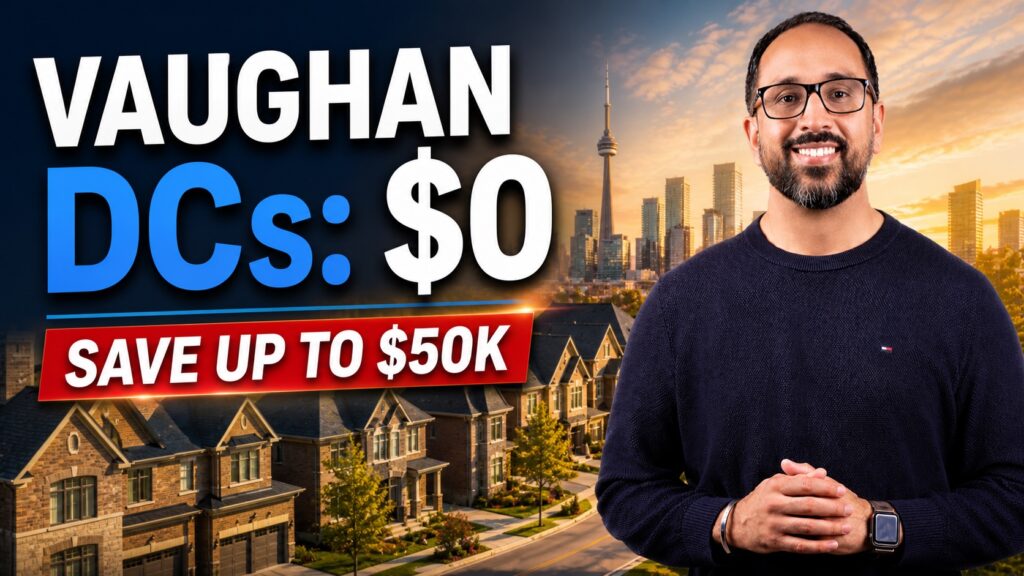
On April 28, 2026, Vaughan development charges dropped to zero. Vaughan is the first major GTA city to do it.
The temporary policy runs from February 25, 2026 through October 31, 2027. New home buyers could save up to $50,193 per low-rise build, and that saving can stack with the federal GST and Ontario HST rebates.
Read the full breakdown below, or explore the Canada-Ontario 50% DC plan that started it all.
Vaughan Development Charges Just Hit Zero. Here’s the Full Picture.
On April 28, 2026, Vaughan Council voted to wipe residential Vaughan development charges down to zero. It’s a big move, and a surprising one. Moreover, it lands right in the middle of a much bigger conversation already happening at the federal and provincial level.
If you’re buying a new home in Vaughan, sitting on a pre-construction deposit, or thinking about selling, this affects you. However, the headlines aren’t telling the whole story. So let me walk you through what actually changed, who really benefits, and what to keep an eye on over the next 18 months.
I’ve worked Vaughan’s market for 15+ years. In that time, I’ve seen a lot of policy announcements come and go. This one’s different, and here’s why.
This Started With Ottawa and Queen’s Park
To understand the Vaughan development charges move, you need to know what happened a month earlier.
On March 30, 2026, Prime Minister Mark Carney and Premier Doug Ford announced an $8.8 billion partnership ($4.4B federal + $4.4B provincial) to push municipalities to cut development charges by 50% for three years. Money flows to the cities only if they sign on. Furthermore, cities have until June 30, 2026 to opt in, and the reduced rates are scheduled to begin January 1, 2027.
That was the offer on the table for every GTA municipality.
However, Vaughan’s response, less than a month later, was to skip the 50% target entirely and go straight to zero. They didn’t wait for the January 2027 start date either. As a result, the zero-DC policy is backdated to February 25, 2026 and runs through October 31, 2027.
In short, Vaughan over-delivered on the federal-provincial framework and moved first. That matters. If you want the full breakdown of the $8.8B deal and what it means across the GTA, I covered it in my earlier post: Canada and Ontario Cut Development Charges 50%: What GTA Buyers Need to Know.
The simple version: Ottawa and Queen’s Park asked municipalities to cut DCs by 50%. Vaughan said we’ll cut them by 100%. That’s the cleanest signal Vaughan has sent to builders, buyers, and other GTA cities in years.
Vaughan Development Charges: From $94,466 to $0 in 18 Months
Vaughan development charges on a typical low-rise home have moved through three big steps in less than two years.
| Date | Action | Low-Rise Residential DC |
|---|---|---|
| Before Nov 2024 | Standard rate | $94,466 |
| Nov 19, 2024 | First reduction by Council | $50,193 |
| Apr 28, 2026 | Reduced to zero (temporary) | $0 |
Source: City of Vaughan announcement, April 28, 2026. Figures are for a typical low-rise residential unit.
Important fine print: This is a temporary policy. It applies between February 25, 2026 and October 31, 2027. After that, DCs come back. The window is real, but it has a hard close date.
What Are Vaughan Development Charges, Anyway?
Plain English. No jargon.
- First, what they are: a one-time fee a city collects from builders when new homes get built. Notably, Vaughan development charges have historically been among the highest in the GTA.
- Second, what they pay for: roads, water, sewers, transit, parks, fire, and emergency services.
- Third, who pays them on paper: the builder, when they pull a permit.
- However, who actually pays them: the buyer. The fee gets baked into the final purchase price.
- Finally, how big are they? Across the GTA, government fees and development charges can add up to 25% to 30% of the price of a new home, per industry data cited by the Financial Post.
So when Vaughan development charges drop to zero on a low-rise build, that is up to $50,193 of cost coming out of every new low-rise unit. The big question is whether that saving lands in the buyer’s pocket, or somewhere else.
Who Wins, Who Pays?
Every policy has a trade-off. This one is no exception.
- First, home builders. Projects sitting on the financial edge can finally move ahead.
- Also, pre-construction investors. Improved project economics, plus more units coming to market.
- Then, new home buyers, if the saving gets passed through. Specifically, TRREB estimates the move could reduce the cost of a new low-rise home by up to $50,193.
- Finally, Vaughan’s housing supply. More shovels in the ground means more inventory, particularly in growth areas like Maple, Kleinburg, and Concord.
- First, existing taxpayers. The infrastructure still needs to be paid for.
- Also, city finances. Vaughan is giving up a major revenue stream tied to growth.
- Importantly, long-term planning. The funding gap will need to be closed through property taxes, debt, or trade-offs in services.
- Eventually, future buyers. Once the window closes Oct 31, 2027, full DCs come back.
The trade-off in plain terms: Vaughan development charges fund the roads, water lines, parks, and transit your new neighbourhood depends on. That cost doesn’t vanish when DCs go to zero. It just shifts. Therefore, whether it lands on property tax bills, city debt, or service levels is something every Vaughan resident should be paying attention to over the next 18 months.
Will the Saving Actually Reach Buyers?
This is the part of the policy people argue about most. My take is below.
TRREB’s position is that this policy could reduce the cost of a new low-rise home in Vaughan by up to $50,193. That’s the optimistic read. However, online public sentiment leans the other way. A lot of folks think builders will quietly absorb the Vaughan development charges saving into their margins.
How Vaughan Development Charges Affect Your New Build Price
Here’s what I’m seeing in Vaughan:
- In a competitive market, some of the saving will land with buyers. When multiple builders are chasing the same buyers, price is the lever they pull.
- For some projects, the saving is the only reason the home gets built at all. Indeed, a lot of Vaughan builds had stalled because the math just stopped working. Without the DC cut, those homes don’t exist. The benefit there is the home existing, not a lower sticker price.
- Compare to Markham and Richmond Hill. Similarly, if a Vaughan new build is priced about the same as a comparable build in a city where development charges still apply, the saving didn’t reach the buyer.
If you’re a buyer: ask the builder, in writing, what the price would have been with full DCs versus the current price. If the answer’s vague, you have your answer. If you’re looking at any pre-construction in Vaughan over the next 18 months, call or text me at 416-830-8305 before you sign. The math is genuinely different now and it’s worth a 10-minute chat. You can also download my free Vaughan Buyer’s Guide for a step-by-step walk-through.
How Vaughan Development Charges Stack With the GST and HST Rebates
Here is where it gets interesting for first-time buyers.
The federal GST rebate eliminates the 5% GST on new homes up to $1M for first-time buyers, worth up to $50,000. Similarly, the Ontario HST rebate covers the 8% provincial HST on new homes up to $1M, worth up to $80,000. Combined, that is up to $130,000 in tax relief on a qualifying new build.
Now stack the zero Vaughan development charges policy on top of that. A first-time buyer in Vaughan looking at a qualifying new build could be looking at savings well into six figures. For folks who’ve been priced out the last few years, that genuinely changes the math.
Worth flagging: every saving here comes with conditions. Price ceilings, primary residence rules, builder pass-through, and timing all apply. For the full details on each rebate, here are my breakdowns of the federal GST rebate and the Ontario HST rebate. If you’d like me to map out your specific scenario, give me a call. No pitch, just the numbers.
What This Means for You
Pick your tab. Practical reads, no fluff.
- First, you may be sitting on real savings. Specifically, up to $50,193 on a low-rise unit per TRREB. Confirm in writing with the builder.
- However, the window has a deadline. The zero-DC policy applies between Feb 25, 2026 and Oct 31, 2027. Therefore, timing matters.
- Also, more inventory is coming. Stalled projects are now financially viable. As a result, expect more launches and more competition between builders.
- Importantly, stack with the GST/HST rebate. If you’re a first-time buyer on a qualifying new build under $1M, the combined relief can be life-changing.
- Finally, don’t assume the saving is yours. Get the price comparison itemized, in writing, before you sign.
- Resale homes don’t pay DCs. So this policy doesn’t directly cut your price. But it changes the competition.
- New-build supply is about to grow. If you’re a resale seller, expect more options for buyers, especially in the freehold townhome and condo segments. My free Vaughan Seller’s Guide walks through pricing strategy in this kind of market.
- Pricing accuracy matters more. An overpriced resale listing competing against new builds with $50K+ DC savings will sit on the market. Start with a free home valuation to see where you stand before you list.
- Resale buyers still have negotiating room. Vaughan’s resale market is balanced (5.3 months of inventory as of March 2026). New supply doesn’t help if you need a home in 60 days. Search Vaughan homes to see what’s on the market right now.
- First, pre-construction math just got better. Lower input costs improve developer margins and may lower your entry price.
- Also, Vaughan is now ahead of its neighbours. If Markham, Richmond Hill, and Mississauga don’t match this, expect builder activity to shift toward Vaughan.
- Specifically, Maple, Kleinburg, Concord. These are the priority growth corridors. Worth the closest look for purpose-built rental and pre-construction.
- However, watch the post-October 2027 cliff. Projects launching after the policy ends will face full Vaughan development charges again. Pricing dynamics could shift sharply.
- First, you don’t get a refund. Whatever you paid in Vaughan development charges when you bought stays paid. This policy is forward-looking only.
- However, property tax pressure is the risk. Vaughan still has to fund infrastructure. If DC revenue drops, the gap closes through property taxes, debt, or service cuts. Therefore, watch the next city budget.
- Also, more neighbours, more density. If supply ramps as intended, expect changes to traffic, schools, and services in growth corridors.
- Finally, long-term equity may benefit. A more affordable, growing Vaughan attracts more buyers. That generally supports values over time.
A Few Things Worth Knowing
A few angles I’d keep in mind that don’t always make the headlines.
-
01For some builds, the win is just that the home gets builtA lot of GTA projects have been on hold because rising costs broke the math. For those, the benefit of zero Vaughan development charges isn’t a cheaper home. It’s the home existing at all. Without this policy, those units don’t get built. That alone matters for supply.
-
02Vaughan just changed the conversation in the GTAOttawa and Queen’s Park asked for 50%. Meanwhile, Vaughan went to 100%. As a result, that puts pressure on Markham, Richmond Hill, Mississauga, and Brampton to either match it or risk losing builder activity to Vaughan over the next 18 months.
-
03Watch what happens at the end of October 2027When the policy ends, Vaughan development charges come back. Projects that close before the deadline get a real cost advantage. Conversely, projects launching just after may struggle on price. If you’re a buyer, that’s exactly why timing inside this window matters.
There’s opportunity in this 18-month window, and there are a few questions worth asking before you act on it. The buyers and sellers who tend to do best in moments like this are the ones quietly working through the details with someone who knows the local market well. Happy to be that person if you’d like to talk.
Policy changes like this make
more sense over a coffee.
I’m Raj Bajwa, a broker with RE/MAX Experts here in Vaughan. I’ve been helping buyers, sellers, and investors think through this market for 15+ years. If you’re weighing pre-construction, comparing new build versus resale, or just trying to figure out how this policy affects your next move, reach out. No pitch, just a conversation.
Free Vaughan Real Estate Tools
Pick your next step. Each tool opens in a new tab so you don’t lose this page.
Follow the Vaughan Market Every Month
I break down Vaughan housing news, TRREB data, and policy changes across my blog, YouTube channel, and social media. Subscribe once. Stay informed all year.
Frequently Asked Questions:
Vaughan’s Zero Development Charges
Straight answers to the questions I am getting this week.
Sources: City of Vaughan · TRREB · BILD · Prime Minister of Canada · Living In Vaughan: $8.8B Federal-Provincial DC Deal | All figures in CAD | Verified May 2026
This article is for informational purposes only and is not financial or legal advice. Consult a licensed real estate broker for advice specific to your situation.